Scroll behaviour: what makes people keep scrolling?
What shapes scroll behaviour? The elements that make visitors keep moving down the page, and how to keep them there.
Selli Porteva · · UPDATED

- Scroll behaviour as a psychological response
- Visual cues that shape scroll behaviour
- The power of content
- Motivation, context and scroll behaviour
- What to avoid
- The takeaway
Scroll behaviour is one of the most important things for marketers, designers and UX specialists to understand. A scroll is not just a movement of the mouse or a finger across the screen. It is an action that signals interest, a search for value and a wish for more. So what exactly makes people keep going down the page?
Scroll behaviour as a psychological response
When someone lands on a page, they quietly ask themselves: “Is this worth staying for?” If the headline is interesting, the design is good and the first few lines offer something of value, there is a good chance they will keep scrolling.
This is where scroll behaviour comes in. If something in the visual hierarchy or the text creates a hook for attention, scrolling becomes a natural response.
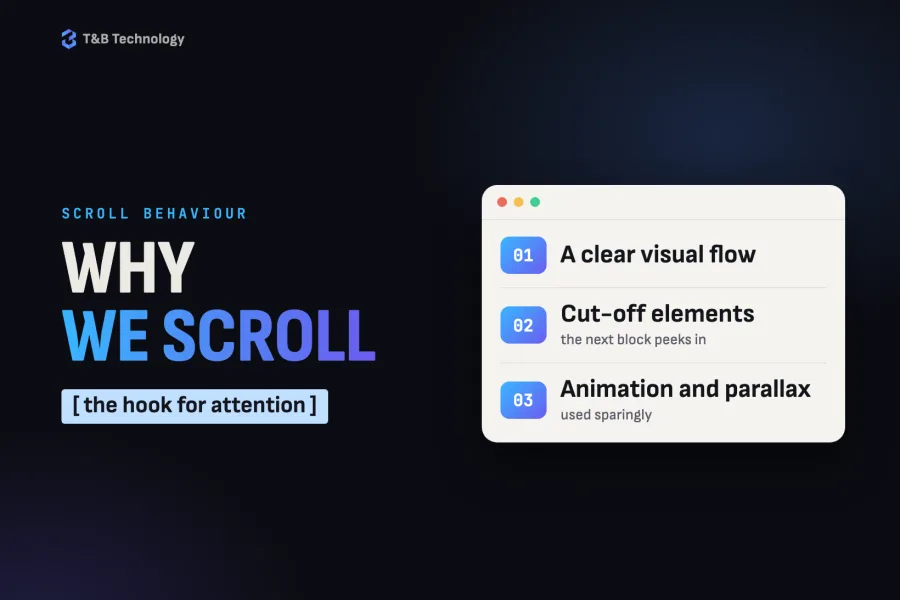
Visual cues that shape scroll behaviour
Design plays a key role. A few elements have a direct effect on scrolling:
- A clear visual flow: the content leads the eye downwards through colour, typography and layout.
- Cut-off elements: when the next block is only partly visible, it sparks curiosity (“What else is there?”).
- Animation or parallax effects, used strategically: they should not be intrusive, but they can make scrolling more engaging.
The power of content
The most important factor in scroll behaviour is the content. However good the design, if the text is dull, confusing or too general, the user simply has no reason to keep going.
Good practice is to:
- Open with a strong headline and subheading.
- Make a promise or a provocation at the start that the rest of the page unfolds.
- Use clear subheadings, lists and visuals to break up the text and keep interest up.
Motivation, context and scroll behaviour
Not everyone scrolls for the same reason. Some are looking for an answer to a question. Some want to be entertained. Others are simply killing time. Understanding this context helps you build a structure that speaks to your particular audience. The same question, who this person is and what they are looking for, sits at the heart of all digital marketing, not just of a single page.
It is important to answer three questions:
- Why is this person here?
- What do they want to learn, find or achieve?
- How can we encourage them to stay?

What to avoid
Sometimes what stops people scrolling matters as much as what keeps them going:
- Large blocks of unbroken text
- Content with no clear message or value
- Misleading headlines (clickbait) that do not live up to expectations
- No mobile optimisation, especially on phones, where scrolling is the main way to get around
The takeaway
Scroll behaviour is more than a habit. It mirrors interest and motivation. To hold a user’s attention, you need to combine good design, valuable content and a psychological feel for when and how a user is inclined to swipe or scroll down one more time. Next time you build a page, do not just ask “How does it look?” Ask “What makes someone want to keep scrolling?”
Graphic design
A face people remember: graphic design from one team.
CASE STUDYArte: social media, TikTok, brochures and campaigns for a food producer
Facebook and Instagram with their ads, videos, a TikTok profile built from scratch, monthly brochures and gift campaigns for Arte — a Bulgarian staple-food brand (rice, beans, lentils, sugar, pasta and preserves) distributed nationwide.