AI in web development: helper or threat?
What role does AI play in web development? How artificial intelligence helps, where the risks lie, and why it does not replace the human factor.
Selli Porteva ·
- What AI in web development means
- How AI is already part of web work
- The benefits of AI for developers
- The potential risks
- Will AI replace developers?
- The takeaway
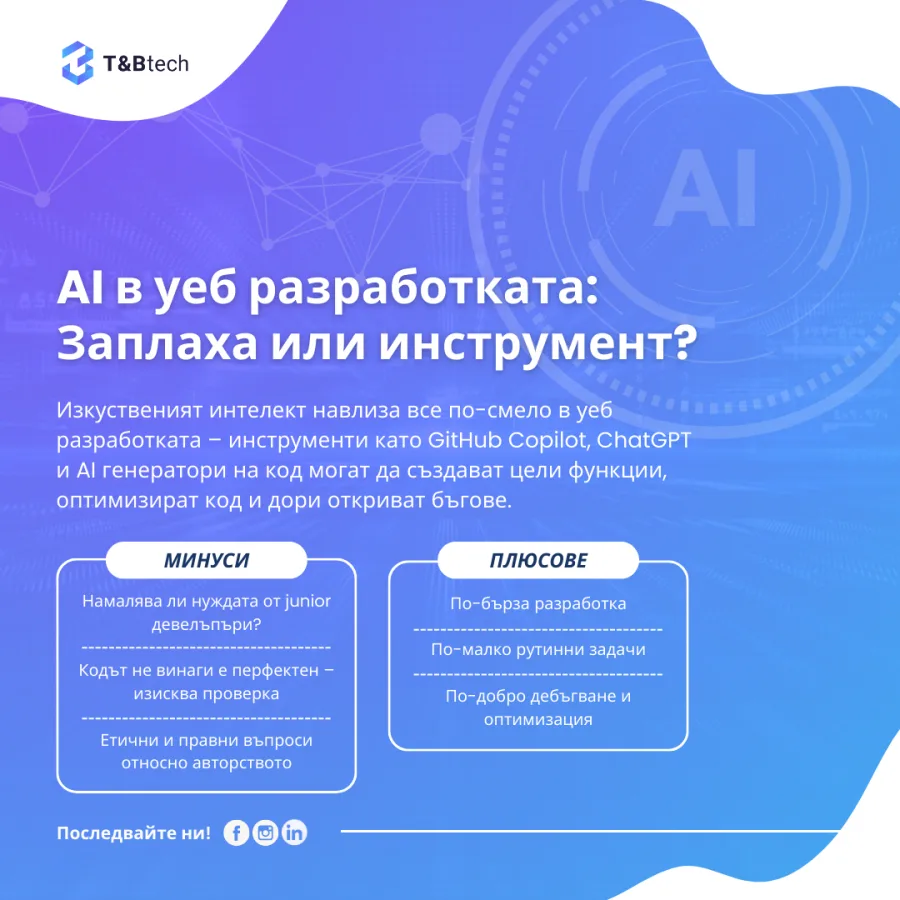
Artificial intelligence is no longer something distant or abstract. It is here, and it is changing how work gets done. In web technology its influence is becoming clearer all the time. AI tools increasingly have a place in building websites, apps and digital products, and they have become a valuable part of the work of developers and teams.
But what does AI in web development really mean? Does it make specialists’ work easier, or does it call into question the need for people at all?
How AI is already part of web work
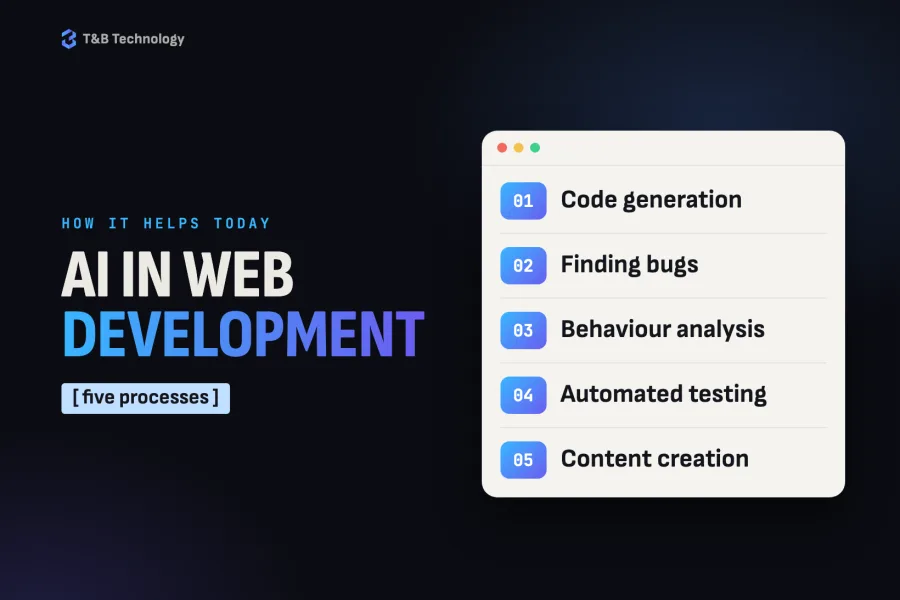
Artificial intelligence plays a bigger part in developers’ day-to-day work than many people realise. Here are a few specific areas where AI is in active use:
- Code generation and autocompletion, with tools such as GitHub Copilot and CodeWhisperer;
- Finding and fixing bugs in real time;
- Analysing user behaviour and adapting the interface to the data collected;
- Automated testing, which speeds up the QA stages;
- Content creation, text or visual, which saves teams time.
These uses shorten development time, and they also raise the quality of the finished product.
The benefits of AI in web development
AI does more than take routine tasks off people’s hands. It changes the way teams plan, structure and deliver projects. The main benefits include:
- Higher productivity: AI speeds up coding, especially for repetitive structures and templates.
- Better accuracy: intelligent systems can spot errors a person might miss.
- UX/UI optimisation: through real-time analysis, AI helps create a better user experience.
- Support for smaller teams: start-ups and small agencies can make up for limited resources with automated solutions.
Combined with human judgement, AI becomes a powerful partner in building modern, fast and effective web platforms.
The potential risks
For all its benefits, AI is not a magic fix for everything. Used without understanding or oversight, artificial intelligence can lead to superficial solutions and even serious problems:
- Loss of skills: relying too heavily on AI can erode programmers’ hands-on abilities.
- Lack of context: AI does not understand cultural nuance, business goals or the emotional side of the user experience.
- Biased results: systems trained on limited data can produce incomplete or wrong conclusions.
- The need for verification: AI-generated code often needs a specialist to review and correct it.
In that sense, AI in web development is a useful tool, but not a substitute for strategic thinking, a designer’s eye and human creativity.

Will AI replace developers?
This is the question people ask most. And although AI is developing at an impressive pace, it still cannot replace critical thinking, communication with the client, process management or the design of a complete product vision. Developers who adapt and make AI part of their toolkit will become more productive, more flexible and more valuable to their teams.
The takeaway: collaboration, not competition
AI in web development is not a threat. It is an accelerator. The real risk is not that artificial intelligence will take people’s jobs, but that developers who refuse to use it will be overtaken by those who do.
Technology does not stand still. Rather than resist it, it is better to look for ways to move forward together, combining human intuition with machine precision. The future of web development belongs to those who know when to use technology and when to trust their own experience and instinct.
Website development
A website that brings in enquiries, clear from the first screen.
CASE STUDYPopov Logistic: a corporate website in 7 languages
A corporate website for Popov Logistic, a freight forwarding company from Ruse, Bulgaria: 7 languages, a 3-step quote form, an admin panel and custom analytics.