How AI is changing consumer habits online
See how AI is changing consumer habits online, from personalisation to behaviour shaped by speed, convenience and anticipation.
Selli Porteva · · UPDATED

Artificial intelligence is now an inseparable part of the digital world we live in every day. From chatbots to recommendation algorithms, it changes not only what we see online but also how we behave online. The result is a new kind of consumer habit: faster, with higher expectations, and often harder to predict with traditional methods.
Understanding this shift is not just a matter of interest in technology. It is a business necessity. Companies that want to stay relevant need to follow how consumer habits are changing under the influence of AI.
Personalisation is rewriting consumer habits
One of the biggest changes AI has brought is the personalisation of content. Algorithms now “know” who you are, what you like, when you are active and what is most likely to hold your attention. Everyone from Netflix and Spotify to TikTok and Amazon uses this approach to meet your individual preferences in real time.
This creates new consumer habits: the expectation that everything will be tailored to you, that no time will be lost searching, and that every digital encounter will deliver value within the first few seconds.
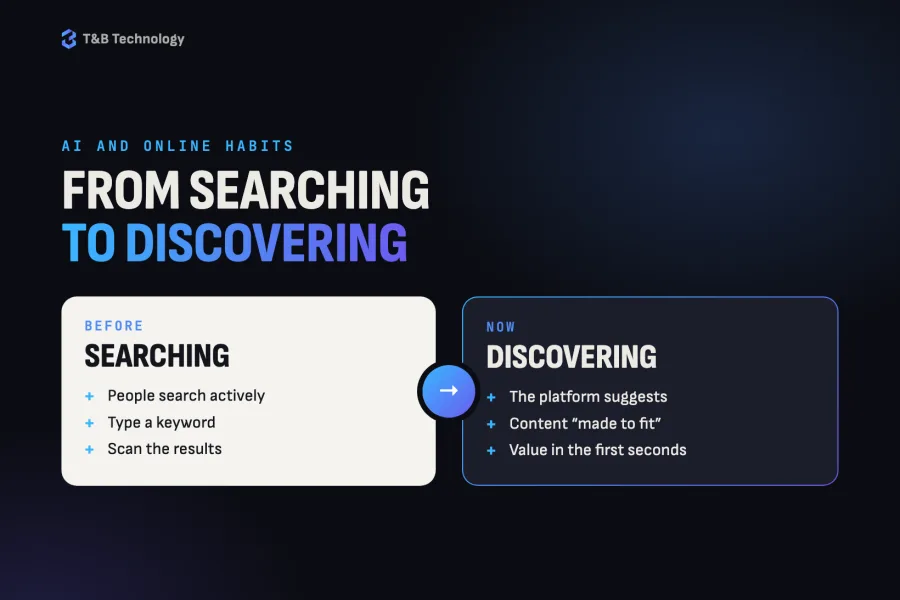
New consumer habits: from searching to discovering
Active searching used to be the main way people used the internet. Today they increasingly come across content they did not even know they wanted. Thanks to AI, platforms serve content based on past actions, the time of day, location and other behavioural signals.
This changes consumer habits at a deep level, from a logic of intent (“I want to find something”) to a logic of reaction (“I respond to what I am shown”). For content creators, this means being not just informative but intuitive, and even predictable.
Behaviour shaped by speed and convenience
AI makes things faster, and that changes expectations. People get used to instant answers, shorter processes and automated purchases. A new standard takes hold: if something does not happen “right now”, it is not good enough.
These consumer habits demand websites that are lightning fast, navigation that is intuitive and forms cut down to the minimum. Response time has become a key factor in customer satisfaction.
Digital loyalty now depends on algorithms
Loyalty used to be won with excellent service, a strong brand identity and steady communication. Today people stay loyal to the platforms that “understand” them, whether that is a streaming service or an online store.
Here again, consumer habits are the deciding factor. Loyalty is no longer a matter of feeling but of efficiency. If the AI model offers more relevant suggestions, an easier purchase and a better experience, the customer simply stays.

An ethical approach to new consumer habits
AI also brings responsibility. Personalisation can easily turn into manipulation. Building dependence on certain content, artificially narrowing the range of viewpoints or automating choice too far can all lead to a loss of autonomy.
That is why understanding new consumer habits has to go hand in hand with ethical design: design that meets users’ needs and also respects their freedom of choice.
The takeaway
Artificial intelligence is changing not only the tools we use online, but also the way we think, how we react and what we expect from the digital world. The new consumer habits taking shape every day are the result of complex algorithms and dynamic experiences, and businesses need to respond to them in the right way.
The most successful brands will not be the ones that simply “use AI”, but the ones that understand how it is changing human behaviour and create experiences that fit these new patterns.
AI-shaped habits are one of three sides of the same shift in how people find things. For the whole picture, and for what we publish on this site (add “.md” to the end of any page’s address to check), see SEO and AI search.